After years of trying to build its own base in Punjab, the BJP has reunited with the Shiromani Akali Dal. Despite polling nearly 20% of the vote in the 2024 Lok Sabha elections, it failed to win a single seat. Now, it has accepted the Akalis as senior partners, with Amit Shah calling them the “big brother”. Does this alliance reflect a change in BJP's political ambitions ? Is the party putting its independent growth on hold to gain access to the Akalis' rural support or using the alliance to strengthen its future position ? Has the BJP given up its ambition to lead Punjab politics or is it using the Akalis as a stepping stone to expand its influence ?
A) BJP is prioritising electoral gains over independent growth.
B) The alliance gives BJP access to rural voters.
C) Accepting the Akalis as senior partners may limit BJP's leadership ambitions.
D) BJP could use the alliance to build its own base for the future.
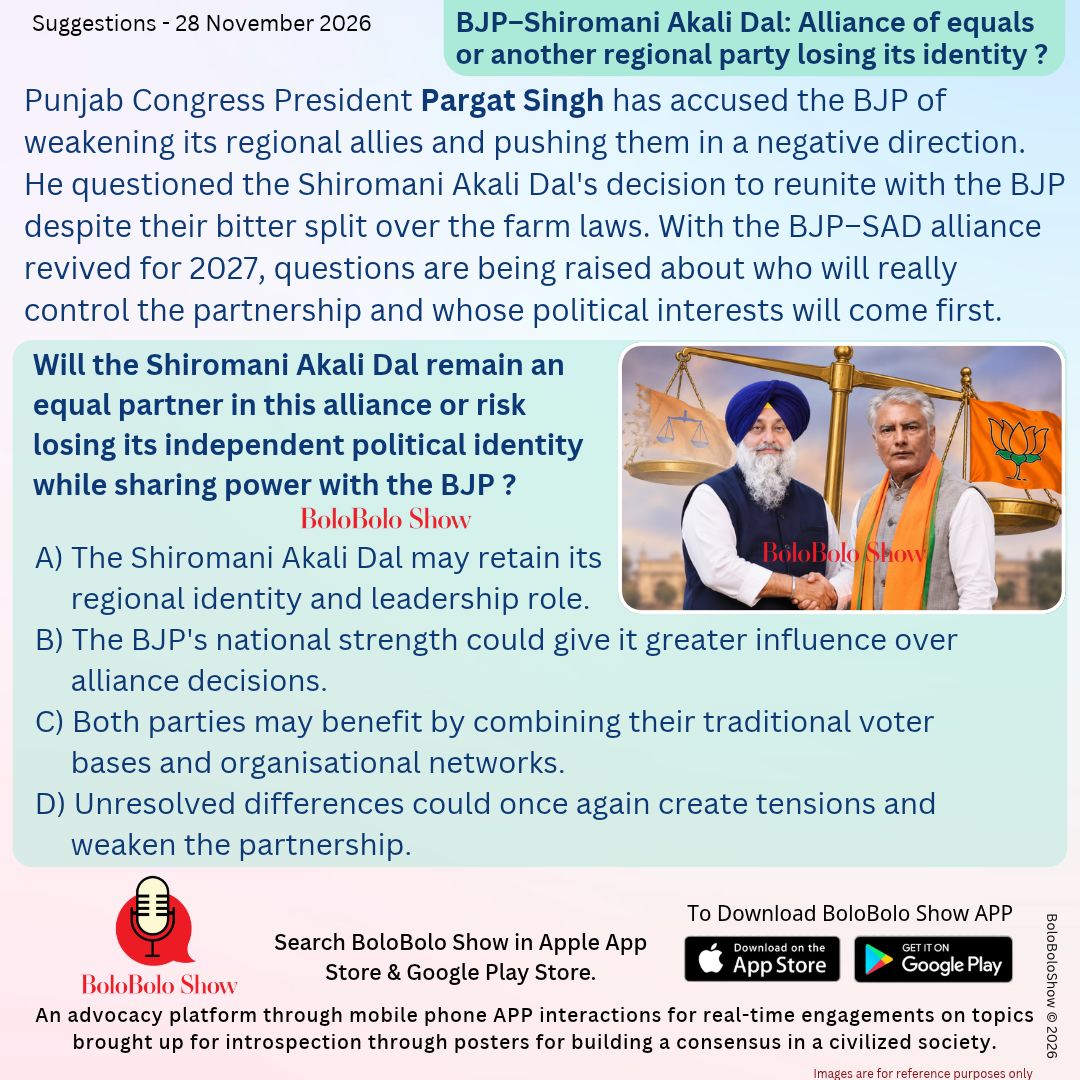
Punjab Congress President Pargat Singh has accused the BJP of weakening its regional allies and pushing them in a negative direction. He questioned the Shiromani Akali Dal's decision to reunite with the BJP despite their bitter split over the farm laws. With the BJP–SAD alliance revived for 2027, questions are being raised about who will really control the partnership and whose political interests will come first. Will the Shiromani Akali Dal remain an equal partner in this alliance or risk losing its independent political identity while sharing power with the BJP ?
A) The Shiromani Akali Dal may retain its regional identity and leadership role.
B) The BJP's national strength could give it greater influence over alliance decisions.
C) Both parties may benefit by combining their traditional voter bases and organisational networks.
D) Unresolved differences could once again create tensions and weaken the partnership.
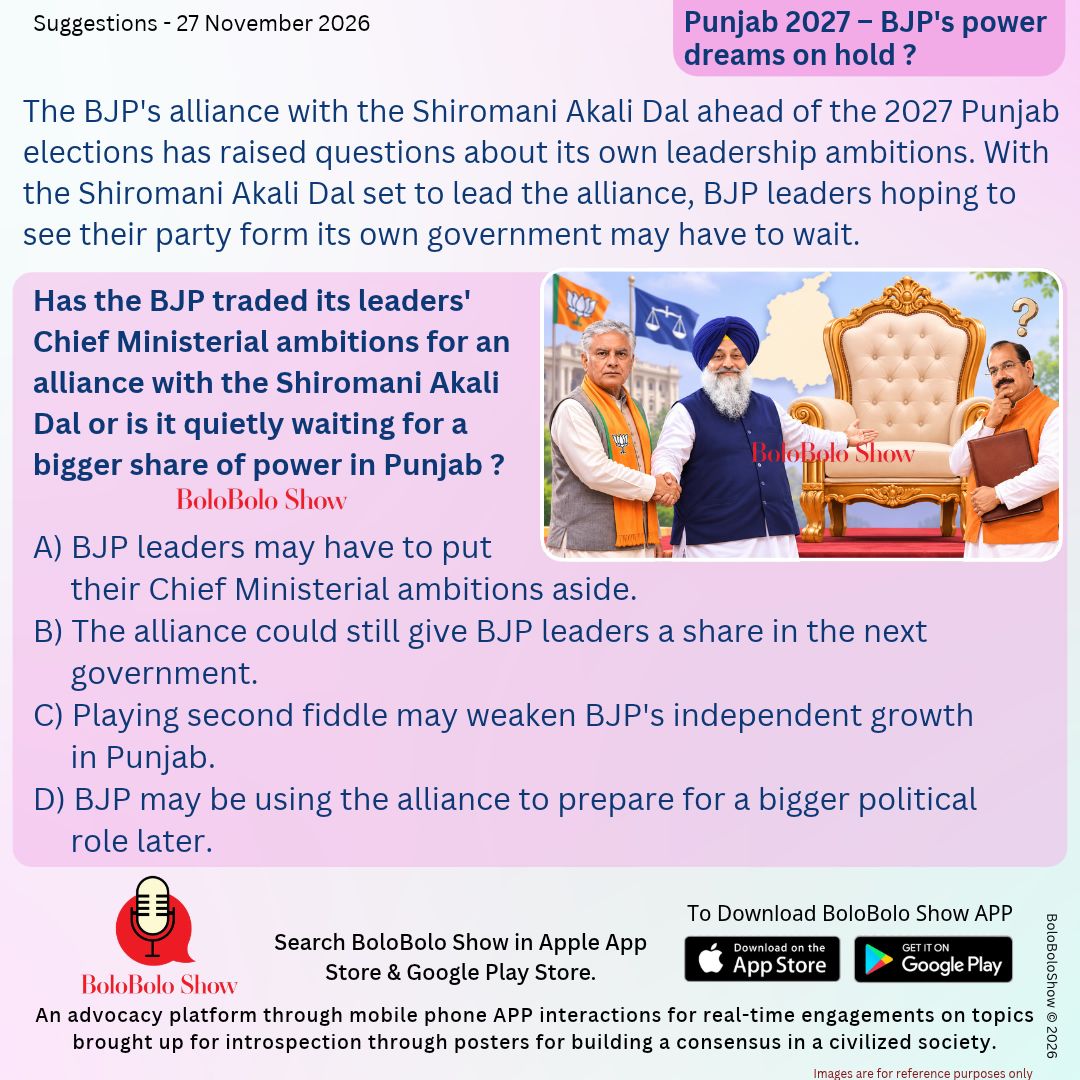
The BJP's alliance with the Shiromani Akali Dal ahead of the 2027 Punjab elections has raised questions about its own leadership ambitions. With the Shiromani Akali Dal set to lead the alliance, BJP leaders hoping to see their party form its own government may have to wait. Has the BJP traded its leaders' Chief Ministerial ambitions for an alliance with the Shiromani Akali Dal or is it quietly waiting for a bigger share of power in Punjab ?
A) BJP leaders may have to put their Chief Ministerial ambitions aside.
B) The alliance could still give BJP leaders a share in the next government.
C) Playing second fiddle may weaken BJP's independent growth in Punjab.
D) BJP may be using the alliance to prepare for a bigger political role later.
Union Minister C.R. Patil, a trusted Narendra Modi aide from Gujarat, played a key role in shaping the BJP's Punjab strategy. His surveys reportedly helped build the case for reviving the alliance with the Shiromani Akali Dal ahead of 2027. Does the BJP's reliance on Modi's trusted Gujarat strategist show that Punjab's political decisions are being shaped more in Delhi than on the ground ?
A) The alliance reflects a data-based decision backed by ground surveys.
B) The BJP's central leadership is shaping Punjab's political direction.
C) The BJP still needs the Shiromani Akali Dal's rural network to expand in Punjab.
D) Local BJP leaders deserve a stronger say in decisions about Punjab's future.
Ferozepur Urban was once a stronghold of the BJP but the party has lost the last three Assembly elections here. Now, six leaders are competing for the 2027 ticket, including former minister Rana Gurmeet Singh Sodhi. Aspirants are building public support through social, religious and cultural events. The BJP faces a tough choice: satisfy competing leaders or focus on rebuilding its lost support base. Can the BJP reclaim its old stronghold or will the fight for one ticket expose the divisions that have weakened the party in Ferozepur ?
A) Rana Gurmeet Singh Sodhi's experience as a four-time MLA and former minister could strengthen the party's campaign.
B) Local leaders deserve priority over candidates who joined the BJP from other parties.
C) Too many ticket aspirants could deepen factionalism and weaken the party's campaign.
D) The party must choose a candidate who can unite workers and reconnect with voters.
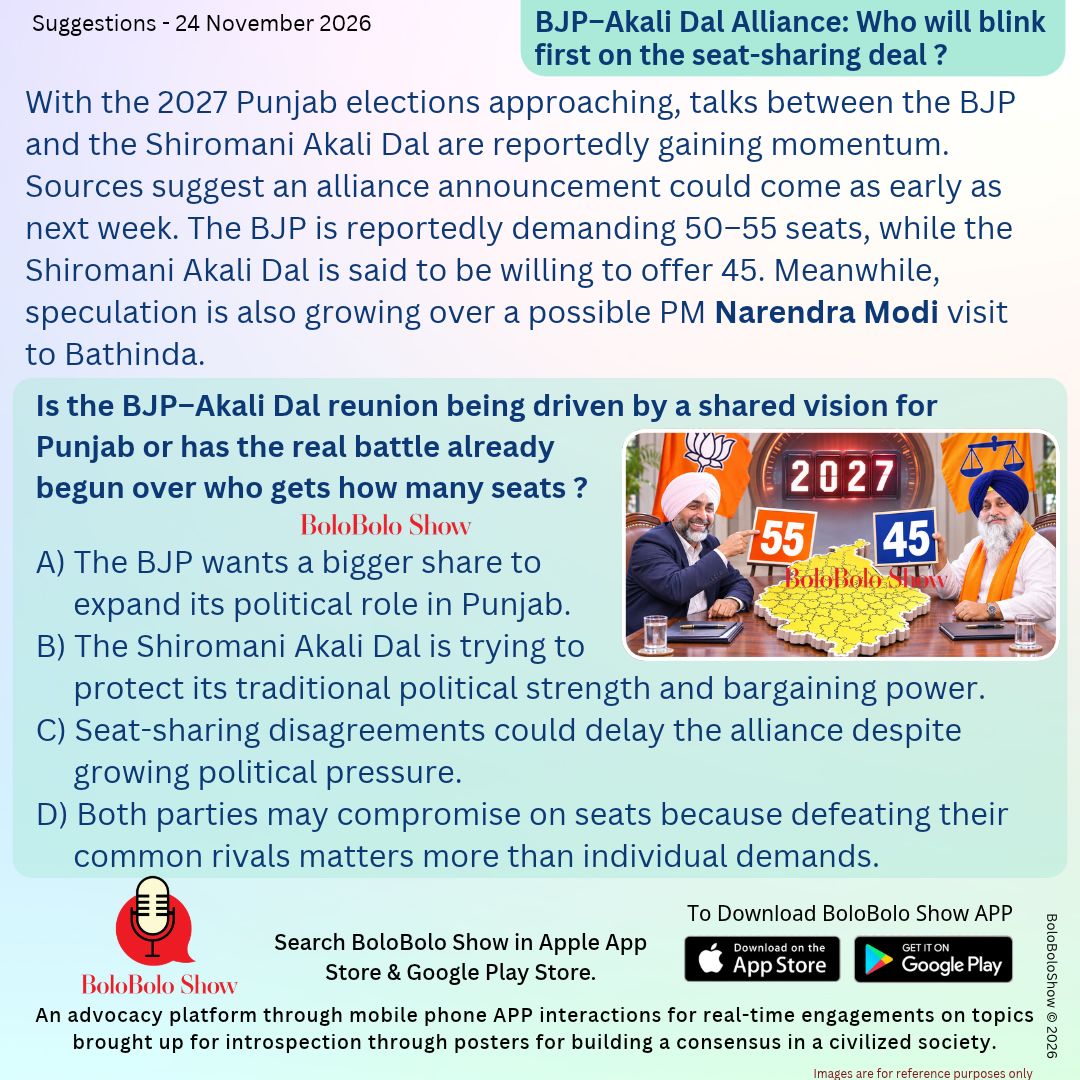
With the 2027 Punjab elections approaching, talks between the BJP and the Shiromani Akali Dal are reportedly gaining momentum. Sources suggest an alliance announcement could come as early as next week. The BJP is reportedly demanding 50–55 seats, while the Shiromani Akali Dal is said to be willing to offer 45. Meanwhile, speculation is also growing over a possible PM Narendra Modi visit to Bathinda. Is the BJP–Akali Dal reunion being driven by a shared vision for Punjab or has the real battle already begun over who gets how many seats ?
A) The BJP wants a bigger share to expand its political role in Punjab.
B) The Shiromani Akali Dal is trying to protect its traditional political strength and bargaining power.
C) Seat-sharing disagreements could delay the alliance despite growing political pressure.
D) Both parties may compromise on seats because defeating their common rivals matters more than individual demands.